AA's Popular Posts

Wednesday, April 20, 2011

Jury Convicts Executive in $3B Mortgage Fraud Case

Lee Farkas was convicted on all 14 counts in a $3 billion fraud trial.

Jury Convicts Executive in $3B Mortgage Fraud Case

By Matthew Barakat

ALEXANDRIA, Va. -- A jury on Tuesday convicted the majority owner of what had been one of the nation's largest mortgage companies on all 14 counts in a $3 billion fraud trial that officials have said is one of the most significant prosecutions to arise from the nation's financial crisis.

Prosecutors said Lee Farkas led a fraud scheme of staggering proportions as chairman of Florida-based Taylor Bean & Whitaker. The fraud not only caused the company's 2009 collapse and the loss of jobs for its 2,000 workers, but also contributed to the collapse of Alabama-based Colonial Bank, the sixth-largest bank failure in U.S. history.

The jury returned its verdict late Tuesday after more than a day of deliberations.

Colonial and two other major banks - Deutsche Bank and BNP Paribas - were cheated out of nearly $3 billion, prosecutors estimated. Farkas and his cohorts - six of whom entered guilty pleas to related charges and testified against him at the two-week trial in U.S. District Court - also tried to fraudulently obtain more than $500 million in taxpayer-funded relief from the government's bank bailout program, the Troubled Assets Relief Program (TARP).

While TARP at one point gave conditional approval to a payment of roughly $550 million, ultimately neither Taylor Bean nor Colonial received any TARP money, and investigators from that office, along with the FBI and other agencies, helped uncover the fraud.

Farkas testified in his own defense at the trial and claimed he did nothing wrong. He claimed he was unfamiliar with details or knowledge of many aspects of the various fraud schemes.

In closing arguments, Farkas' lawyer Bruce Rogow, said the six executives at Colonial and Taylor Bean who struck plea deals skewed their testimony to bolster the government's case in the hope of receiving lighter prison sentences for their cooperation. Rogow said Farkas and everyone else at Taylor Bean was working honestly and ethically to get control of its finances and perhaps could have done the job if the government hadn't essentially shut the company down when it raided company headquarters in 2009.
But prosecutors said the evidence against Farkas was overwhelming. They said the fraud began in 2002, when Taylor Bean overdrew its main account with Colonial by several million dollars. Midlevel executives at Colonial agreed to transfer money into Taylor Bean's accounts at the end of each day to avoid generating overdraft notices, a process known as "sweeping."

As the hole grew to well over $100 million, Taylor Bean and a handful of Colonial executives concocted a scheme in which Taylor Bean sold hundreds of millions in worthless mortgages to Colonial - mortgages that had already been sold to other investors. More than $1 billion in such phony mortgages were eventually sold to Colonial, which listed them on its books and on its quarterly reports as legitimate assets, prosecutors alleged.

In a related scheme, Taylor Bean created a subsidiary called Ocala Funding that sold commercial paper - essentially glorified IOUs - to banks including Deutsche Bank and BNP Paribas. But prosecutors said the collateral that supposedly backed that commercial paper was worthless, and when Taylor Bean collapsed in 2009, the two banks lost roughly $1.5 billion.

Tuesday, April 19, 2011

Author's Tall Tale Comes to Light


Greg Mortenson's Stories From 'Three Cups Of Tea' Called Into Question By '60 Minutes'

After telling his life story, Greg Mortenson sold millions of books and raised tens of millions of dollars for his charity.
After "60 Minutes" aired on Sunday night, some observers may find the whole thing too good to be true.
"It's a beautiful story, and it's a lie," Jon Krakauer told CBS' Steve Kroft. Krakauer, an author and adventurer like Mortenson, originally backed the education nonprofit, Central Asia Institute, with $75,000 of his own money before withdrawing his support. He wasn't the only one to find fault with Mortenson's claims, which include being nursed back to health in the Pakistani town of Korphe after failing to summit K2 (the second tallest mountain on Earth) and being kidnapped for eight days by the Taliban.
There's little doubt that Mortenson's efforts have produced some results for children in need -- even his detractors acknowledge that much. But many people Kroft spoke with did question whether Mortenson has exaggerated his success and even fabricated parts of the legend that helped him get where he is today.
Kroft talked to sherpas who said there was no recovery visit to Korphe on that original K2 trip. He talked to men who denied being in the Taliban and denied the alleged kidnapping, contrary to the accusations that ran with their photos in Mortenson's book, "Three Cups of Tea." They even produced a photo showing Mortenson posing with the group and holding an AK-47 himself. Kroft talked to Pakistani educators who said they haven't seen money from the Central Asia Institute in years, that buildings funded by Mortenson were poorly made, and that some of the facilities weren't being used for their intended purpose. He also talked to a nonprofit expert who questioned the financial practices of the organization and why so much money had been spent promoting Mortenson's books.
After conducting interviews all around the world, the one person Kroft had trouble talking to was Mortenson, who refused to speak with "60 Minutes." But he did issue a statement to the Bozeman Daily Chronicle. In it, Mortenson denied most of the specific allegations from the show, though acknowledged the story about Korphe was "a compressed version of events." He maintained that he was "detained" by the men he had claimed were in the Taliban, and defended the relationship between his personal finances and those of his organization.
Click here to read the story in the Bozeman Daily Chronicle, and watch the "60 Minutes" segment below:


Monday, April 18, 2011

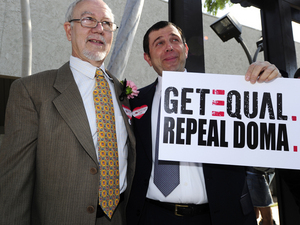
Republicans Mount Defense Of Anti-Gay Marriage Law


Republicans Mount Defense Of Anti-Gay Marriage Law

Sunday, April 17, 2011

Online poker companies indicted for fraud

Online poker companies indicted for fraud

By Ben Rooney

The founders of the three largest Internet poker companies have been indicted for bank fraud and money laundering, federal law enforcement officials said Friday.
The United States Attorney in New York unsealed the indictment against eleven people, including the founders of PokerStars, Full Tilt Poker, and Absolute Poker. In addition to charges of bank fraud and money laundering, the companies are accused of illegal gambling offenses.
The sweeping 52-page indictment alleges that the companies, based offshore, used "fraudulent methods" to get around U.S. anti-gambling laws "and to receive billions of dollars from U.S. residents who gambled through the Poker Companies."
The authorities also issued restraining orders against more than 75 bank accounts, and seized five Internet domain names used by the companies to host their illegal poker games.
The companies allegedly arranged for the money from U.S. gamblers to be disguised as payments to hundreds of non-existent online merchants for the purchase of items such as jewelry and golf balls, according to the indictment.
The defendants include Isai Scheinberg and Paul Tate of Poker Stars; Raymond Bitar and Nelson Burtnick of Full Tilt Poker; and Scott Tom and Brent Beckley of Absolute Poker.
"As charged, these defendants concocted an elaborate criminal fraud scheme, alternately tricking some U.S. banks and effectively bribing others to assure the continued flow of billions in illegal gambling profits," U.S. Attorney Preet Bharara said in a statement. Prosecutors also filed civil charges against the poker companies and several individual "payment processors," seeking at least $3 billion in penalties.
Prosecutors also alleged that John Campos, a part owner of SunFirst Bank in Utah, agreed to process Internet gambling transactions in exchange for a $10 million investment in his bank by one of the other defendants.
Prosecutors said they are working with Interpol and foreign agencies to secure the arrest of the remaining defendants, who are not presently in the United States.
"These defendants, knowing full well that their business with U.S. customers and U.S. banks was illegal, tried to stack the deck," said Janice Fedarcyk, FBI assistant director-in-charge. "They lied to banks about the true nature of their business. Then, some of the defendants found banks willing to flout the law for a fee."
The indictment shines a light on Internet gambling in the United States.
"The operation of their business is illegal, and in about half the states the player himself is violating state law," said Denver attorney Chuck Humphrey, who runs a Website dedicated to online gambling laws.
Alfonse D'Amato, chairman of the Poker Players Alliance, said he was "shocked" by the indictments, adding that his group "will continue to fight for Americans' right to participate in the game they enjoy."
"Online poker is not a crime and should not be treated as such," D'Amato, a former U.S. Senator, said in a statement.
Humphrey said Internet poker companies have argued in court that online poker is legal because it is a game of skill, as opposed to a game of chance.
But he pointed to recent cases involving online sports gambling, which resulted in jail time for some defendants, as an example of what might happen to those indicted Friday.
By charging the defendants with bank fraud, a criminal offense, Humphrey said prosecutors stand a better chance of extraditing them from countries where gambling is legal.
It was not immediately clear what will happen to any money that U.S. citizens had in accounts associated with the poker companies.
In 2007, federal prosecutors charged NETeller, an online payment company, with taking part in an online gambling conspiracy. That case resulted in a so-called deferred compensation agreement, in which the company agreed to return $94 million to U.S. customers.

Saturday, April 16, 2011

An Interview With True-Life Husband and Wife Spies


An Interview With True-Life Husband and Wife Spies

by Kate Fridkis


Crown Publishing
It's a classic love story. A woman and a man meet in a war-torn country. They are both spies. The man doesn't even know the woman's real name, but they fall in love and make a wild, adventurous, globe-trotting, and somehow totally normal life together.

So maybe it's not a classic story, but it's a fantastic one, and Dayna and Robert Baer make it come to life in "The Company We Keep", their new book about life and love in the CIA.

Though this is the first book the couple has written together, Bob Baer 's memoir, "See No Evil", was adapted into the movie"Syriana", which starred George Clooney and Matt Damon. And no wonder-- He's kind of the superspy you might imagine if you tried to imagine a super spy (and I, of course, have tried). Dayna, much newer to the job, is just as ready for action. Flying across the world on a moment's notice? No problem.

Their friends have names like Sheikh Hamad bin Jasim bin Hamad Al Thani and "the Black Prince." Their friends sometimes can't remember whether they spent $10 million on property in Maine or Colorado (what? Those American states all sound the same!). Dayna finds herself taking a princess lingerie shopping, and standing on guard in the hair salon behind a queen, one hand on her Glock.

Yet life in the CIA isn't all romance and international adventure, and the Baers find themselves struggling with some of the same issues that everyone faces when they decide to start a family. The Company We Keep puts a human face on the shadowy silhouette of that almost mythical figure: the international covert operative.

Want to know what it's like being a spy? MyDaily did. And we got to talk all about it with Dayna Baer. She was a lot less mysterious than anticipated. Maybe we should send the CIA an application?

MyDaily.com: So, we're all wondering, how much is being a spy like the movies? I've been watching Nikita way too much. Did you ever do anything like her, or like James Bond? 
Dayna Baer: You know, it's so funny because the book really, really well describes the reality of it. There's just some really boring and tedious moments and bureaucracy, and then there's some really exciting fun things. A lot of it is the training. You get trained to death, and then the times that you actually get to use your training are so few and far between. People always ask, did you ever kill anybody? No ... I never killed anybody. But yes, I carried a gun, and sometimes I was really happy that I had that gun on me.

So no incredibly sexy outfits?
I didn't wear a ninja suit and I didn't do any wheel kicking. But you do wear a lot of disguises, and sometimes it's a little like acting.

Did you get to make up your aliases, or characters, or were they assigned to you?
Some of them are made up, because you want to do something that you're really comfortable with. You think, "I'll be like my friend so and so." Or sometimes you use hobbies or things that you're interested in in real life. I had friends who were private pilots, so sometimes when they were working they'd say, "I'm a pilot," and like I said in the book, I'm from LA, so the movie industry's familiar to me, so I often said that I was a location scout. Because it's easy to be anywhere in the world with a camera, and everyone loves movies.

What inspired you both to write this book? Why did you write it as a team? 
Well, Bob's been a writer for a while, and he's always loved writing. I eventually went to law school, and all lawyers are frustrated writers -- I was really emotionally moved by our adoption, so that sort of spurred it on. I also sort of hoped that just by telling the reality of it, it reflects what it's like, because there are so many people and families who spend their whole lives in the CIA, and there are sacrifices along the way. And it's just a different life. There are lots of rewards but lots of sacrifices. Just because of the culture of the job. You can't say what you do. You can't share what you do. Especially case officers. They spend their lives overseas.

What about your family and friends? Did they know? 
Um...no. Not for a long time. Not until a long time after we'd already left the CIA.

So what did you tell people? 
My friends thought I worked for an international moving company. Because you have to explain why you're gone all the time. And my parents thought I worked as a civilian for the military.

Someone I was talking to said, "I must have a really whacked out family, because I could keep that secret from them." I think that on some level my parents knew that whatever I did there was some security to it. On some level they just knew not to ask.

What was your job description in the CIA? 
I was considered an operations officer. I have a feeling that that title has changed since then. I did support operations, which sounds really nebulous. I did security operations.

What about Bob?
Bob was known as a "case officer". They are actually the ones who go out and handle the people, like the foreign nationals that are doing the spying. They recruit them. If they want some sort of secret documents or something, they'd go out and find someone in a foreign country who could get that document for them.

As an operations officer, a lot of the time I was supporting the case officers. Bob would go some place and stay for two years. working in a country and making contacts, whereas I never went some place for two years, but I was constantly like, 6 weeks here, and then 6 weeks somewhere else.

What was your life like before the CIA? Did you fantasize about the glamorous life of a "international woman of mystery"? 
(Laughs)...No. I was in graduate school at UCLA and I was studying social welfare and working with gang kids, and it was all really different from my suburban upbringing. It was at that time that I thought, "Wouldn't it be cool to work for the FBI or the CIA?" I saw the recruiting posters on campus. Like any graduate, I applied lots of places, and it just sort of -- all of a sudden the CIA called.

What was that like? 
You sort of know they're looking into you. I did an interview in LA and was flown to an interview in DC. It takes over a year because they have to do such a long background investigation. So you sort of know you're in the pipeline. And then one day they just call and say, "Hey, we're ready to hire you." I had a job by that time, I was working as a social worker, and I thought, "Why not?"

So Bob. He sounds kind of like the quintessential superspy. But you say in the book that it wasn't love at first sight. How did you resist? 
I just thought he was crazy when I first started working with him. I didn't know what his reputation was, but I realized after working with him for a while that he's so dedicated to what he was doing, and all his not playing by the rules and not playing it safe got him results...

It's also very attractive to have somebody that's so into what they're doing. So after a while I was just like, "Huh ...This guy's pretty interesting."

Can you give our readers a brief overview of where you were and what you were doing when you met Bob?
So we were in Sarajevo and he was managing an operation that was tracking Hizballah, and i was assigned to his operation. It was like, "OK Bob, here's your support." There was a team of us helping him. And the very first time I met him, we were at some restaurant at the river and he was smoking a cigar and hanging out with some locals, speaking the local language. He's a very friendly guy.

It was the end of a war, so there were no hotels. He had found this house that had extra rooms, and I had to move in there temporarily. Everyone asks if we had some sordid affair, but nothing happened between us romantically until we were back in the States. There was just no time for messin' around.

I love the way you put that. Even after you got back to the U.S. and left the CIA, you both ended up in Iraq, with ABC News. What was it like, being in Iraq right before US troops arrived?
Um ... it was scary. We were actually in the Middle East, we were going between Jordan and Syria, with ABC News, just waiting until it was safe enough to actually go. We had been asked to go in and wait out the war with some of Bob's tribal friends, and there were a lot of other journalists doing that.

I guess it didn't seem completely real to me, until the tribal people we were going to stay with -- their house was bombed and all the women and children and men we were going to stay with were killed. It really shook me, because they were people I had met and people Bob had known for years and years. So we did go in, but it was scary. You drive in a convoy. And you just don't know what's going to happen. We got there just as the statue of Saddam came down. We were driving around the country and you'd hear gunfire. But at that point all the news organizations were there. So safety in numbers.

What's life like now, living with your ex-spy husband and beautiful adopted daughter? Do you ever miss the adventure? Do you have any habits that you retained from life in The Company? 
I think we do. You're so used to get-up-and-go, to seeing a new place, having some new adventure. So it's hard to stay in one place. We have this run-down cabin in Colorado and this place in Berkeley. Bob stays very involved with political things and still keeps many, many connections overseas. He did a documentary on suicide bombers. And you know, we get our chance to get out--- but now we also have this little three-year-old girl. But that's all completely worth it. This is a different adventure, which I'm sure every parent would say!

That's great. 
She's skis. She skis on her own. And she plays ice-hockey and just goes everywhere with us.

And you always have something to talk about at dinner parties. 
It's always a topic of conversation. There's lot of things you can't talk about, though.

Speaking of that, did the CIA have to review and approve this book before publication? 
Oh yes. They did. That's their job. We worked with them a lot. To make sure there was nothing that was classified in it.

So what you're saying is that we didn't get the full story ... and we never will. 
Yeah ... probably.

We'll just have to wonder.
It's not like we know everything either. It's very compartmentalized. Just because you work there doesn't mean you know all the secrets. It's need to know and you only know the stuff you need to.

Friday, April 15, 2011

Slaying of Virginia Lacrosse Star Yeardley Love Going to Grand Jury

Yeardley Love, a University of Virginia women's lacrosse player, was found dead in her apartment on May 3.


Slaying of Virginia Lacrosse Star Yeardley Love Going to Grand Jury

By David Lohr

Enough probable cause exists for the murder case against former University of Virginia lacrosse player George Huguely to move it forward to a grand jury, General District Judge Robert Downer has ruled after an emotional nine-hour hearing attended by many friends and family members of the victim and her former boyfriend.

Huguely, 23, is accused of felony murder, assault, robbery and burglary in the 2010 death of his former girlfriend, UVA student Yeardley Love, 22, and the theft of her computer. She was a star on the school's women's lacrosse team.

Defense attorney Fran Lawrence continued to maintain during Monday's hearing that the death was an accident and that Huguely was not even aware Love was dead when he left her apartment that night. It was only after police began to question him and Huguely repeatedly inquired about her well-being that an officer reportedly said, "She's dead. You killed her, George," Lawrence recounted.

"She's not dead. I didn't, I didn't, I didn't," Huguely said in response, according to Lawrence, The Cavalier Daily reported. "I never did anything that could do that to her."

Today, Love's family released a statement to ABC's "Good Morning America":

We miss Yeardley so very much and will work tirelessly to make her proud of us. It is truly devastating to wake up each day and realize she is no longer here. Her bright, bright future was stolen from us all. Yeardley's contagious smile, kind spirit and gentle touch have left this world, but we know heaven now has an angel like no other. ... We have faith in the justice system and trust that the truth will prevail.
Charlottesville police officers were called to Love's off-campus apartment nearly a year ago -- on May 3 -- to investigate a possible alcohol overdose. When officers arrived on the scene, they found Love dead in a bedroom. She had "obvious physical trauma," police said. One of Love's eyes was swollen shut, her face was bruised and there was a pool of blood on her pillow.

"It was quickly apparent ... that this young lady was the victim of something far worse," Charlottesville Police Chief Timothy Longo told reporters shortly after Love's body was discovered.

Investigators and forensic personnel from the Charlottesville Police Department spent most of the first day on the case examining the crime scene. Meanwhile, detectives learned that Huguely and Love had been involved in a relationship at some point.

George Huguely
Charlottsville Police Department / AP
A grand jury is expected to convene next week to decide whether to indict George Huguely in Love's death.
Love, a resident of Cockeysville, Md., graduated in 2006 from Notre Dame Prep, where she had been a member of the lacrosse and field hockey teams. Like Huguely, she was a senior at the university at the time of her death and was expected to graduate in two weeks.

According to an affidavit requesting a search warrant, Huguely told police that he kicked his foot through the door to Love's bedroom and got into an argument with her, during which he "shook" her and her head "repeatedly hit the wall."

The search warrant affidavit also states that Huguely told police he removed Love's computer from the apartment. That laptop was later retrieved by the police and is considered evidence in the case.

During Monday's court proceeding, more than 20 witnesses were called to testify. They included friends of Love and Huguely, police investigators, the medical examiner who conducted Love's autopsy and a biomechanical engineer, Charlottesville's The Hook reported.

Love's roommate, Caity Whiteley, was the first witness called. Testifying for prosecutor Dave Chapman, Whiteley described how she walked into their apartment and discovered her best friend's lifeless body.

"I saw Yeardley in bed face down with a comforter over her," Whiteley said. "I shook her shoulder. I moved her hair to the side and touched her shoulder." When Love did not respond, Whiteley said she took a closer look at her face, saw blood and called 911.

Love died from blunt force trauma and sustained injuries to her brain, neck and mouth, according to medical examiner Dr. William Gormley.

Former roommate Kevin Carroll said Huguely had been drinking most of the day and was "definitely drunk" at the time of Love's death.

The defense has contended that Huguely had no motive for killing Love, whom friends have described as an "on-again, off-again" girlfriend with whom he was trying to get back together. He has been incarcerated in Albemarle-Charlottesville Regional Jail for the past 11 months.

Downer decided to send the case to the grand jury, which is expected to convene next Monday, when it will decide whether to formally indict Huguely on the six counts.

Following Monday's court hearing, Huguely's attorneys read a statement on his behalf outside the courthouse, calling Love's death a "tragedy but not an intentional criminal act."